
Worth the trip? Without doubt yes. Michelangelo’s ‘Madonna and Child’ (1501) Bruges ‘The Madonna of Bruges’ Monuments Men Bruges Madonna.

Having first been stolen by the French and only returned in 1816, it has now subsequently been brought to cinematic fame by George Clooney’s film ‘The Monuments Men’.
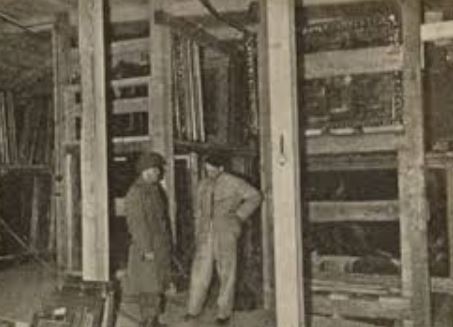
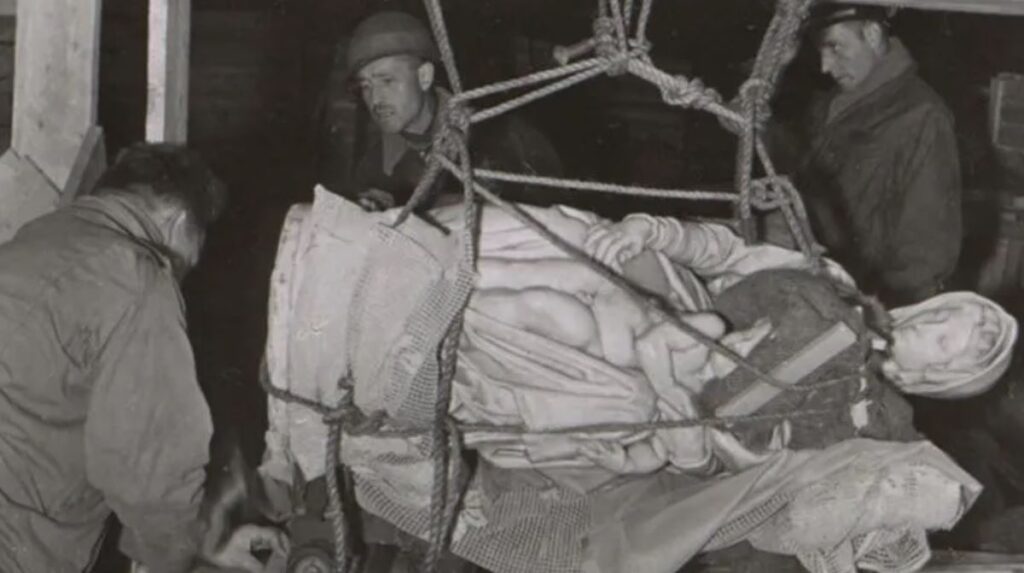

This tells the story of the piece’s second abduction by the retreating Nazis in WWII, its storage in the salt mines of Alt Aussee, Austria and its subsequent return by the UK and USA’s arts rescue troops.
You escape from the bustle of commercial Bruges and are guided through to the museum quarter of the church (more on that below) and turn a corner and in silence, behold the masterpiece. Your breath is drawn, and you feel a tightening of your chest as you gaze in awe at this work. Your emotions express a privileged elevation into its omnipresence. I’m standing here in the company of something of wonder created by somebody with the touch of the other-worldly.
The piece is actually sublimely simple. A statue of a mother and child, but its rendering could by many be considered ‘divine’ as Vasari attributed to Michelangelo. Look at the surrounding sculptures and what at first could be thought of as a modest piece, becomes a work of supreme genius not only in the obvious physiological depiction but in its subtle yet obvious psychological depth, its esoteric mysticism.
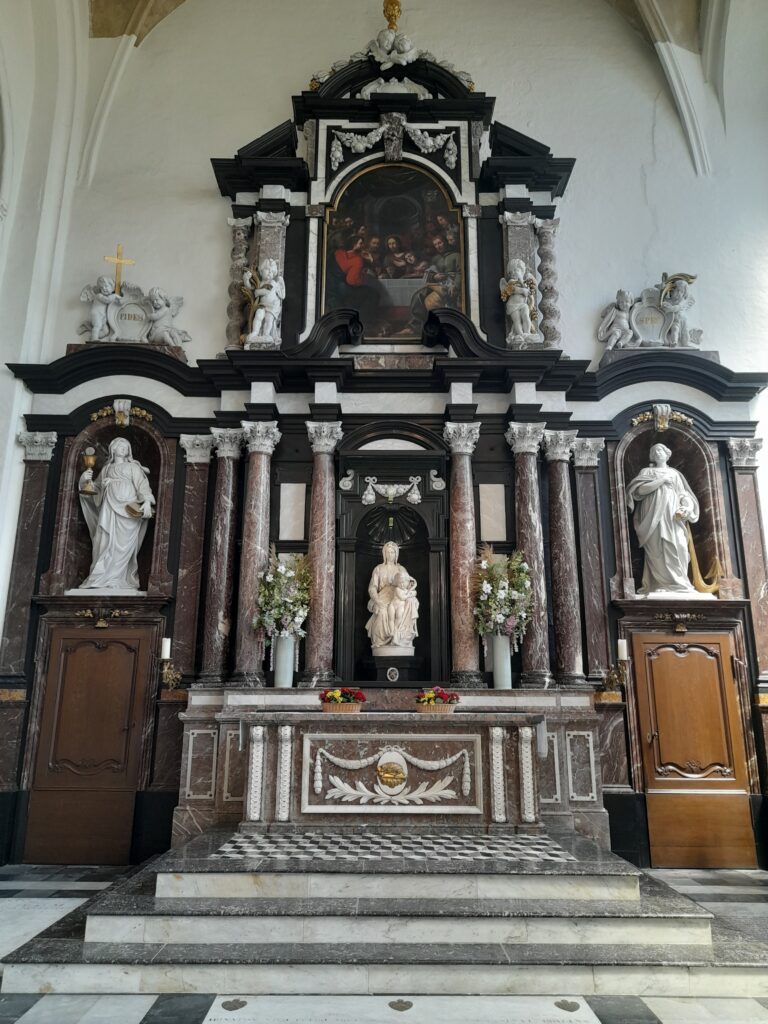
Allow a little interpretation. Here is a mother seemingly looking down in fondness and love at her only child. However, look more closely, Mary is in fact looking down traditionally to her right, beyond her son. She is in prayer with a foretelling of her son lying prone in her lap after his deposition and the lamentation.

Michelangelo’s ‘Pieta‘ is the future as foretold by this Madonna.

The child is already showing distinct signs of independence from her. He’s standing without support, he’s almost starting to walk away from his mother. Mary is looking with thoughtful poignancy, perhaps at his ensuing independence and with a foreknowledge of what is lying in store for him, flagellation and crucifixion.
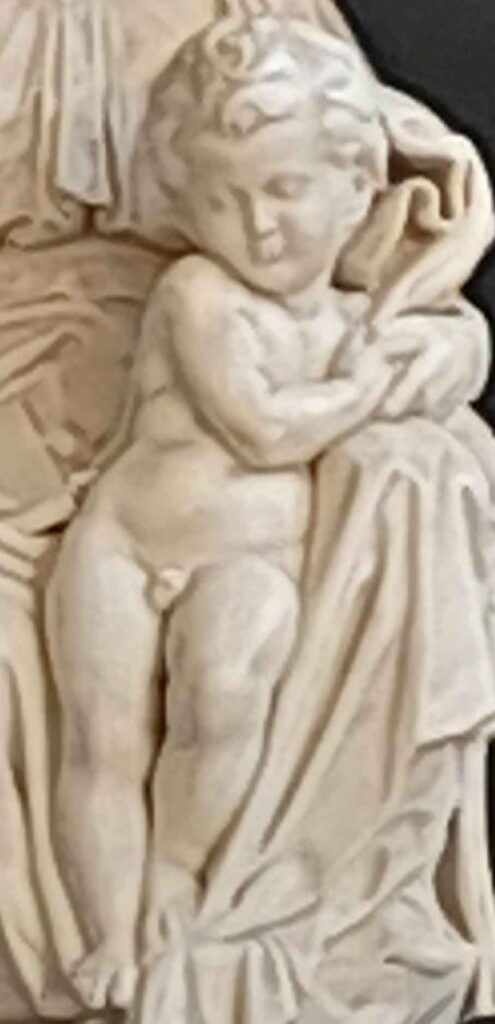
One could also be tempted to read into her expression a forecast of the immense affect that her birth and his existence will have on the future of humankind. The Christian story and all of its implications.
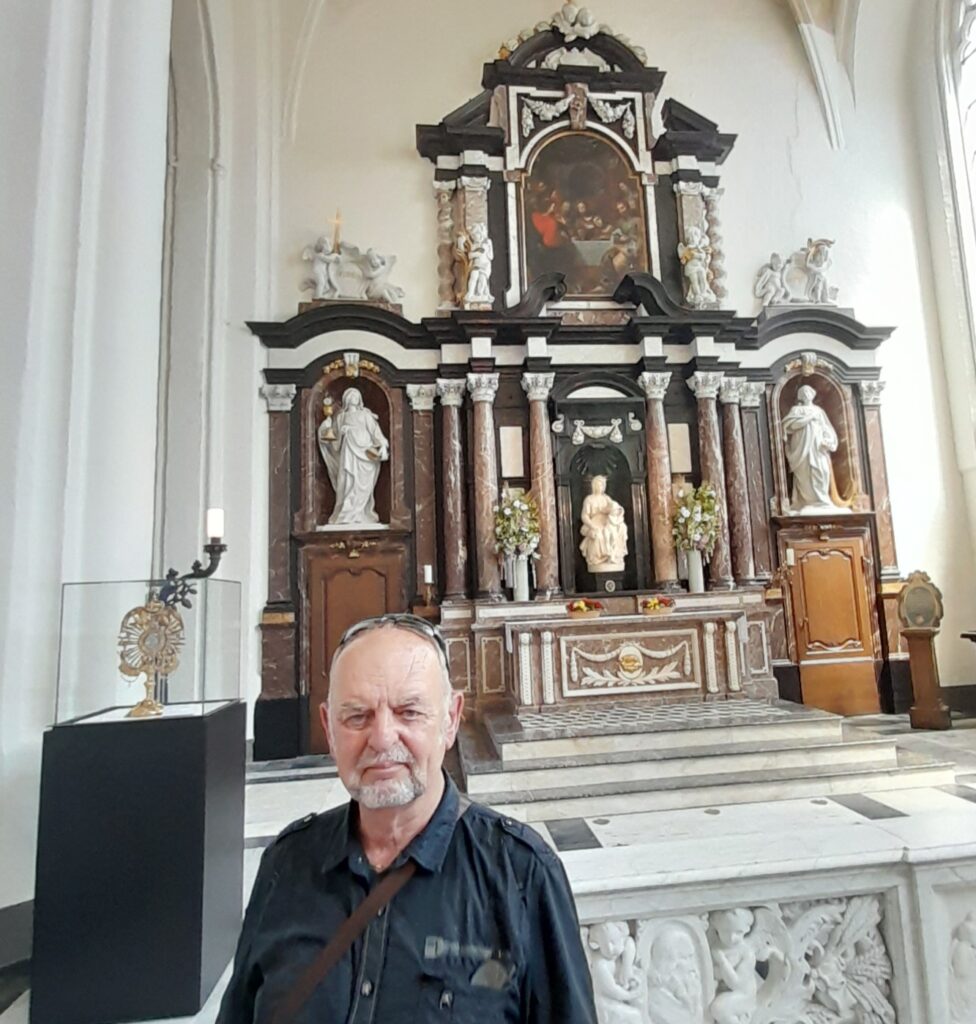
The ‘Madonna of Bruges’ is housed in Onze Lieve Vrouwekerk, Bruges. Donated in 1514 by Jan Mouscron and his wife, whose remains lie beneath the altar. This Gothic building began construction in the 13th Century and reflects the wealth of the city at the time thanks to trade (the sea was then nearby) textiles and finance. The Church of Our Lady still functions as a church but the very clever and imaginative administrators have divided the building into two components. The church, the museum (8 euros entry) and herein resides Michelangelo’s masterpiece.
It becomes immediately apparent that as well as dividing the religious from the secular functions, the original light absorbing grey stone is now painted a luscious cream. Consequently the interior is a blaze of light in complete contrast to the usual Belgian and French gothic Catholic churches entombed in a deathly grey aura.
The affect could be considered as bringing the history and religion of Christianity alive and welcoming, overpowering the drab dread of mediaeval fear of the Almighty rather than the bright shining light of the heavenly promise.
Bruges is now a city devoted to tourists with the expense, sometimes exploitation, hustle and bustle, and even the inside of its churches have moved over to the business of accommodating the thrill seekers and got the shirt trippers scraping together a little of the ‘ought to’ culture between meals and souvenir shops.
Separating out the ‘divine’ by posing a fee at least gave a pause from the hullaballoo that is now Bruges.
The ‘Madonna of Bruges’ is truly a masterpiece as all of Michelangelo’s works are, and is also a fantastic story of survival still to enrich with magnificence and yet humbleness, humanity in its great march forward.
Monuments Men Bruges Madonna
Some key dates in context:
1503 Leonardo paints the Mona Lisa
1504 Michelangelo carves the sculpture ‘David’ in Florence
1505 Italian artist Giorgione paints The Tempest
1505 Pocket watch invented by German clockmaker Peter Henlein
1506 Ancient Roman sculpture Laocoon discovered
1507 German mapmaker Martin Waldseemüller proposes that the New World is named America
1510 Polish Nicholas Copernicus theorises that Earth revolves around the Sun.