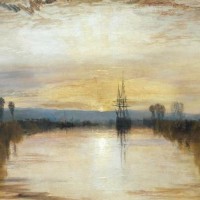
It can be overwhelming when wandering into galleries packed with art. Where to start? What should I concentrate on? I don’t want to miss anything. Sometimes to the extent that things are missed because of the sheer complexity of choice. Take the National Trust’s Petworth House for instance. At some stage in its history it was owned by George Wyndham, 3rd Earl of Egremont (1751-1837), who often invited his friend JMW Turner to visit and paint the house with its Capability Brown grounds and surrounding area. Work your way through the substantial art works until you reach the back long dining room, overlooking the grounds where you’ll see a number of Turners installed at chest height in the walls. Easy to spot, easy to explore. Here we can see how Turner moved on from his earlier ‘Claudesque’ to developing his … Continue reading JMW Turner at Petworth House

Giorgione at The Royal Academy – and Babies
Whilst the Royal Academy prepares for its Summer Exhibition, the upper galleries feature works by Giorgione and an array of Italian High Renaissance artists. The subdued lighting of the first gallery highlights the rich portraiture of Bellini, Durer, Cariani and Giorgione. Images looking across your shoulder or peering askance at you the gazer, the subjects immortalised for us to still stare at. What are their backgrounds, their stories? What are the provenances of the works? Who over the centuries has stood there in front of them like us, and wondered ‘who were these people?’ Move on through the token display of landscapes to where we are presented with a collection of devotional images created both for intimate and public worship. The iconic Italian Renaissance Madonna and Child – all the same but different. With collections like this, why not take … Continue reading Giorgione at The Royal Academy – and Babies
Russell Coates Gallery Bournemouth
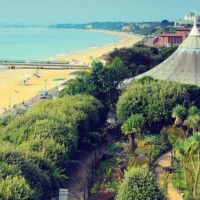
Russell Coates is a cabinet of curiosities, a gem clinging to the clifftop in the formerly grand seaside town of Bournemouth. It was built and habited by Sir Merton and Lady Annie Russell Coates at a time when Bournemouth was fashionable and stylish – the end of the 19th Century. That era has now sadly passed well away for the town. Nevertheless, the Russell Coates Gallery gives the visitor a taste of the town’s grander times with its delightful excesses of Victoriana décor, furnishings, stunningly tiled walls and floors and sumptuously painted ceilings. It is almost like stepping back in time, so have the museum’s owners and curators kept faithfully to the past whilst accommodating thousands of visitors to what must now be the town’s only site of worthy visit. From an art historian’s point of view, the paintings and … Continue reading Russell Coates Gallery Bournemouth
Piero Della Francesca ‘The Resurrection’
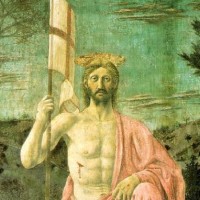
Piero Della Francesca, Italian Early Renaissance artist, whose circa 1450 work, ‘The Resurrection’ referred to in my Easter Saturday newspaper, brought a transcendental light on the road to Damascus moment to my mind. The power of art – to weave a story, to provide a narration, to inspire, to challenge, to comfort. What does Francesca’s ‘The Resurrection‘ mean for you? To me, my story – here is the power of the fecundity of nature, resurging from the dark days of winter to bring renewal, growth and vitality back to the land and us, all awakening from our slumbers. Our noble Earth, a mere yet significant speck in the vast dynamism of the universe. Urging to evolve, to establish to replenish, to rebirth, to make good the wrongs and injuries inflicted upon it and us. Humankind as a vital component within mother nature, within … Continue reading Piero Della Francesca ‘The Resurrection’
Painting the Modern Garden: Monet to Matisse. Royal Academy
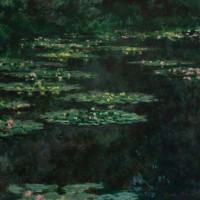
Vibrancy, colour, vitality, yet an oasis of scenes of serenity and peace. That’s the first impression I gained as soon as I entered this exhibition. You could almost be forgiven for thinking you could smell and touch the amazing displays of artistic prettiness, your indulgences only interrupted by the tramping of thousands of feet flattening and laying bare the surely rich lush grass on the RA’s gallery floors. This is not an art exhibition in the traditional sense. There’s no avant-garde, no ‘isms’, no individual artist on display, no angst, drama or socio-economic, politico-religious commentary. It is simply an exhibition of many artists’ love of their gardens. Nothing more, nothing less. As with all good horticultural catalogues, you stroll through a garden path enjoying the company of Manet, Monet, Morisot, Renoir and even Pissarro and onto Van Gogh through to … Continue reading Painting the Modern Garden: Monet to Matisse. Royal Academy
Leonardo at London’s National Gallery
Recently visited London’s National Gallery – just to catch up on a few old friends – paintings that is and my priority was Leonardo’s ‘Cartoon’. ‘Cartoon’ – a sketch, a preparatory drawing for a full scale painting – which incidentally Leonardo never completed for this work. Nevertheless the power of Leonardo’s deep understanding of the human psyche is there, probably more so as a drawing as you can see his every mark, undisguised by paint, colours or brush-strokes. Look at how Jesus is pulling away from his mother whilst she reluctantly is letting him go to his destiny – and we all know what that was to be – he will, as we all do, die and Mary knows this. Mary has brought life and death into the world. He is growing up and pulling away and is already … Continue reading Leonardo at London’s National Gallery
Vincent at Musee d’Orsay
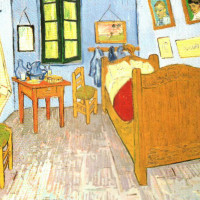
At the Musée d’Orsay Paris, I couldn’t help pondering in front of Vincent Van Gogh’s ‘Room in Arles’ 1889. Look at the solid horizontal and vertical lines and a couple of diagonals too. The inside of a building, a room, furniture: solid, strong and reliable as are Vincent’s brush strokes and colour: frank, lively, vigorous and rapid yet depicting a scene of rest and retreat. Vincent’s artistic style and his choices of colour are deliberately contained and self-restrained by the simple solidity of the subject matter. The then unknown Van Gogh really tried to sell his works, but this subject matter, less so the style as this was at the time of the Impressionists, was too personal to appeal to a purchaser. After all, who would want a picture of an itinerant artist’s bedroom? What would it be worth today? … Continue reading Vincent at Musee d’Orsay
The World Goes Pop at Tate Modern
The World Goes Pop at Tate Modern : Wham, bang, wow, the impact hits you. As you enter you are assailed by vibrant colours and dramatic images. A sensual assault. Yet the once unsettling icons are now within our comfort zone: Tricky Dickie, the bomb, female sexual emancipation and protests. We are reminded that the world was as complex then as it is now. Pop Art grew out of the 1960s mass consumerism and commercialisation, primarily in the UK and the USA, Warhol, Hall, Hockney and Lichtenstein being the principle proponents. But here we have the influence of ‘Pop’ as enjoyed in places such as Slovakia, Romania, Belgium, Austria and France. Hardly then places of mass consumerism. And so the works displayed are a pale imitation of the dramatic impact ‘Pop’ made in the UK and USA. They are almost … Continue reading The World Goes Pop at Tate Modern
Ai WeiWei at The Royal Academy
The Ai WeiWei exhibition at The Royal Academy ran from 19th September to the 13th December 2015 One of the most popular, outstanding and perhaps controversial exhibitions of recent times, Ai WeiWei certainly used the opportunity well to present to us his unique if not egotistical perspective on cultural values, political totalitarianism and the fragility of the human condition. Much has been written on the exhibition so all I want to do here is to draw retrospective attention to 3 of the exhibits that stood out for me. Coloured Vases 2015 I was at first appalled. Sacred, ancient works of art irredeemably vandalised. Irreplaceable treasures destroyed. A sacrilegious destruction of precious elite works. But then I thought, precious to whom? Precious to the elite? For the pleasure of the few? The artist’s simple act of vandalism is bringing alive the … Continue reading Ai WeiWei at The Royal Academy
The Jackson Pollock ‘Blind Spots’ Exhibition
A visit well worth making is the Jackson Pollock ‘Blind Spots’ Exhibition at The Liverpool Tate. The gallery itself is an impressive refurbishment from a conventional Victorian warehouse from Liverpool’s dockland past. Surrounded by trendy eateries and gift shops, the gallery is neighboured by the spanking new Museum of Liverpool building and of course the ubiquitous Mersey Ferry now splendidly ‘dazzled’ by Sir Peter Hall with resonances of Sergeant Peppers and the Yellow Submarine. The Pollock exhibition contains many of his works from his late period, intermixed with his more familiar works such as ‘Number 9A Summertime’ on loan from Tate Modern London. It takes time and patience to absorb the works on display, to enter into Pollock’s mind-set and become involved in what he was trying to achieve. Of central consideration is the message of his emphasis of deliberate … Continue reading The Jackson Pollock ‘Blind Spots’ Exhibition