
Johannes Vermeer Art of Painting – I’m in the middle of my final draft of a book entitled ‘A Conversation with a Picture’. An illustrated guide to enjoying art, with a few words attached.
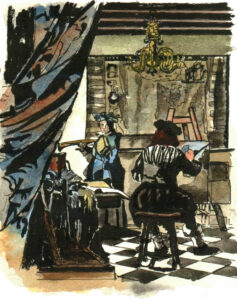
Johannes Vermeer is loved by many and in my book I expand on the story of his work ‘Art of painting’ here below.
Johannes Vermeer was born in 1632 and died in 1675. He was centred mainly in the Dutch towns of Delft and The Hague.
In 1653 he married a Catholic woman, Catharina Bolnes. They had 15 children, four of whom were buried before being baptized.
The Art of Painting was painted between 1665 and 1668, opinions on its exact date differ.
The work shows a painter sitting before an easel painting a woman posing before a map and a window.
At the time the Dutch had recently secured independence from Spain after 80 years of struggle leading to the Treaty of Westphalia. The Netherlands United Provinces governance became decentralized and religious tolerance was strong.
In terms of art history, this is the Dutch Golden Age. With the north and west Netherlands being now a Calvinist Protestant country there is no religious imposition on artists to comply with their dictates. Hence, the Golden Age sees freedom of expression and a wealth of newly formed ‘genre’ and personal paintings, that is works showing ordinary people in everyday situations. In the south and east the country remained under the Catholic Church.
The Dutch East India Company was formed in 1602 and was the first joint-stock companies in the world. The Dutch were trading across the known world. Hence the merchant classes were rich and on the rise. Trading hubs were Amsterdam and Rotterdam.
Trade was especially centred on spices, ceramics and textiles from Asia and the New World.
Merchants became the new commissioners of art. Dutch homes were not large. Artists painted canvasses of the size to be accommodated in these homes.
Contemporaries for Vermeer were Frans Hals and Rembrandt.
Looking at the content of The Art of Painting, the elegantly dressed artist is thought to be Vermeer although there is no direct evidence of this. The female dressed in blue with floral headdress is possibly his daughter. The map on the wall is showing the newly formed 17 United Provinces and is a proud display of the trading nature of the country.
The painting is an allegory. It is telling a story that needs to be interpreted.
It is thought that Vermeer had a theoretical interest for painting. The female figure is thought to depict Clio the muse as is evidenced by her symbolic laurel headdress and holding a trumpet. Clio is one of nine muses from Greek mythology. A muse of history. Muses were thought to be goddesses inspiring the arts and sciences. Hence Clio here is also holding a book thus a reference to the recoding and study of history to help to ensure the history of past civilizations’ achievements and experiences are not forgotten to help future generations.
Vermeer has painted this work with meticulous technique and innovative use of colour. The use of light and shade as well as the display of perspective is outstanding.
Even though he was hard up at the time of this work, he did not sell the painting but on his death his wife sold it to pay off debts. In 1677 this works was sold but it has remained much of a mystery exactly to whom. It emerges again in 1813, when it was purchased for 50 florins by the Bohemian-Austrian Count Rudolf Czernin and was placed on public display in the Czernin Museum in Vienna.
During World War II it was looted by the Nazis and stored in the Altaussee salt mines before being rescued by the Monuments Men and presented back to the Austrian Government. Its pre-war ownership seems to be a confused story.
The work is now on public display in the Kunsthistorisches Museum, Vienna.