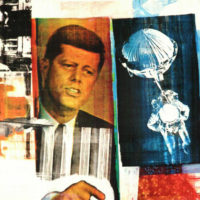
Robert Rauschenburg at the Tate Modern London: What was he trying to achieve? An interpretation Tate Modern London Robert Rauschenburg Exhibition – an understanding of what he was trying to achieve Slap, scrape, gather garbage and stick it on. That’s Tate Modern Robert Rauschenburg Rauschenburg & Detritus – as seen at the Tate Modern Robert Rauschenburg exhibition. Include anything, variety as the key. Detritus, old umbrellas, bike reflectors, bits of fabric and wood as well as furnishing materials. A combination, a ‘Combine’. Whatever seemed to be available, Rauschenburg made use of it for his works to cause controversy and debate. ‘Charlene’ as seen at the Tate Modern Robert Rauschenburg exhibition. Rauschenburg & Ready Mades ‘A picture is more like the real world when it is made out of the real world’ that is the detritus of modern life. Even through … Continue reading Robert Rauschenburg at the Tate Modern
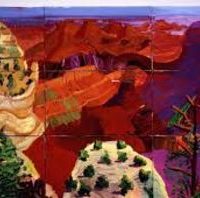
‘9 Canvas Study of The Grand Canyon’
David Hockney ‘9 Canvas Study of The Grand Canyon’ 1998 and ‘The Road Across the Wolds’ 1997. How did he do it? Few photographs can capture the grandeur, awesomeness and sheer drama of the Grand Canyon to compete with David Hockney’s ‘9 Canvas Study of The Grand Canyon’. Few photographs capture the homeliness, intimacy, fecundity and lushness of the rural English countryside than David Hockney’s ‘The Road Across the Wolds’. HOW did he do it? The Grand Canyon: How did he do it? Let’s look at the ‘9 Canvas Study of The Grand Canyon’ first. The first thing that strikes you are the colours, predominantly the reds. Red vibrates, it urges forward towards us. It is the colour of love, drama, blood, life itself and here it reaches out and envelopes us. The scene is not framed – it extends … Continue reading ‘9 Canvas Study of The Grand Canyon’
David Hockney Tate Britain
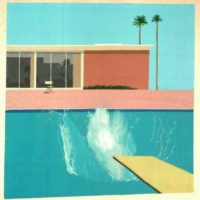
David Hockney Tate Britain ‘A Bigger Splash’ and ‘Peter Climbing Out of Nick’s Pool’ Brief Transient Hedonism David Hockney Tate Britain ‘A Bigger Splash’ and ‘Peter Climbing Out of Nick’s Pool’ When you gaze upon the nubile form of the figure rising from the pool, what you see? What do you feel? What values, attitudes and beliefs of yours rise to the surface with the figure? Transient hedonism all too brief. The 1960s and 70s Los Angeles Gay Californian Lifestyle. Carefree? Socially acceptable? Pre-AIDS. Rejection of social norms? Affluence – the swimming pool, warm and sunny – the blue sky and palm trees. Hedonism. A transient life of our understanding, experience, desire or rejection? Transience and Loss The transience and eventual loss of life and all worldly goods (water does not record our existence, our presence, the splash we make … Continue reading David Hockney Tate Britain
Caravaggio – how did he do it?
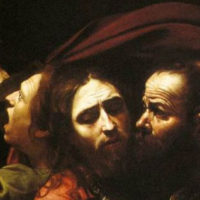
Michelangelo Merisi da Caravaggio simply known as Caravaggio was a bit of a lad and rascal who painted in Rome, Naples and Sicily in the late 16th and early 17th Centuries. If you’ve heard the name, you’ll know the paintings or at least his style: emotional, dramatic and heavy with shadow and exquisite lighting. There’s an interesting exhibition on now at the London National Gallery: ‘Beyond Caravaggio’. Here we have a few examples of his brilliance and many samples of paintings from those who chose to follow his example. Some good but most mediocre. Caravaggio’s works stand out far and above the crowd. So how did he do it? Look at his 1602 ‘The Taking of Christ‘. What are first things you notice? Probably the scene itself and the style and form in terms of drama and lighting. Taking the … Continue reading Caravaggio – how did he do it?
Kurt Jackson: Revisiting Turner’s Tourism
Kurt Jackson: Revisiting Turner’s Tourism. Exeter Royal Albert Museum It was a special trip to Exeter to see this free and wonderful exhibition. The contemporary Cornish artist Kurt Jackson had visited 12 locations in Devon and Cornwall as depicted by JMW Turner. His intention was not to ‘re-do’ Turner but to simply reflect the changes from the early 19th Century to today, in his own style. Wandering through the exhibition one was presented with Jackson’s works alongside the drawings and etchings of Turner, from Boscastle Harbour to Land’s End, through Falmouth, Exeter and the source of the Tamar. Apart from the obvious features reflecting modern industrialisation, tourism and quote ‘sweetie papers’ and ‘loud radio sounds’, by looking into styles and techniques a greater meaningful depth is presented to the viewer. JMW Turner dialectically reacted to the Enlightenment movement to depict … Continue reading Kurt Jackson: Revisiting Turner’s Tourism
David Hockney at the Royal Academy
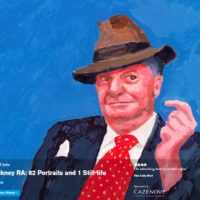
Strolling into David Hockney’s ’82 Portraits and 1 Still-life’ (that person failed to turn up for the sitting) exhibition at The Royal Academy, is a delight to the senses. At first embrace one might be tempted to think ‘mere sketches’ but look more closely and engage carefully with the works and the artist. Apparently Hockney promised his subjects: his friends, family and acquaintances that he’d keep them posed no longer than necessary – just a few hours. Hence the sketchiness, the rapid often coarse paint-work, the flamboyant use of colour, the flat absence of space and perspective, the almost hurried finish . Spontaneity perhaps or a true capturing of the essence of his sitters’ personalities with a few brush-strokes? The sign of a true master. Look carefully at the eyes as windows, many of which are looking directly at you: the … Continue reading David Hockney at the Royal Academy
Botticelli Reimagined at the V&A London
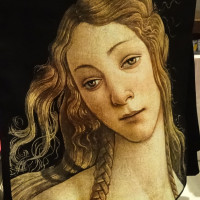
Excellent if expensive for what it is, exhibition at the V&A. As the title suggests, here you are bamboozled at first entry by a number of modern interpretations of Sandro Botticelli’s 1480s ‘The Birth of Venus’, from Monty Python to Andy Warhol, Cindy Sherman to Rossetti, Byrne-Jones and even William Morris. All using Botticelli’s nude Venus icon to stimulate their own imagination and almost emulation of style and stare. With many of the works on display: interesting but best to leave in the imagination. The exhibition is good to wander through, to question ‘why copy?’ ‘what’s so magical about his Venus?’, ‘what’s the symbolism, the meanings behind the component parts and figures?’ It’s also enjoyable to ask oneself ‘the 1480s! Such an early time for such a work, the beginnings of the Renaissance, the exploitation of colour and light, the … Continue reading Botticelli Reimagined at the V&A London
JMW Turner at Petworth House
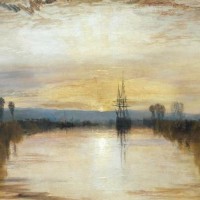
It can be overwhelming when wandering into galleries packed with art. Where to start? What should I concentrate on? I don’t want to miss anything. Sometimes to the extent that things are missed because of the sheer complexity of choice. Take the National Trust’s Petworth House for instance. At some stage in its history it was owned by George Wyndham, 3rd Earl of Egremont (1751-1837), who often invited his friend JMW Turner to visit and paint the house with its Capability Brown grounds and surrounding area. Work your way through the substantial art works until you reach the back long dining room, overlooking the grounds where you’ll see a number of Turners installed at chest height in the walls. Easy to spot, easy to explore. Here we can see how Turner moved on from his earlier ‘Claudesque’ to developing his … Continue reading JMW Turner at Petworth House
Giorgione at The Royal Academy – and Babies
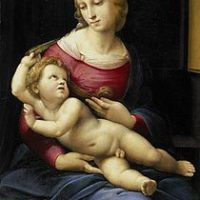
Whilst the Royal Academy prepares for its Summer Exhibition, the upper galleries feature works by Giorgione and an array of Italian High Renaissance artists. The subdued lighting of the first gallery highlights the rich portraiture of Bellini, Durer, Cariani and Giorgione. Images looking across your shoulder or peering askance at you the gazer, the subjects immortalised for us to still stare at. What are their backgrounds, their stories? What are the provenances of the works? Who over the centuries has stood there in front of them like us, and wondered ‘who were these people?’ Move on through the token display of landscapes to where we are presented with a collection of devotional images created both for intimate and public worship. The iconic Italian Renaissance Madonna and Child – all the same but different. With collections like this, why not take … Continue reading Giorgione at The Royal Academy – and Babies
Piero Della Francesca ‘The Resurrection’
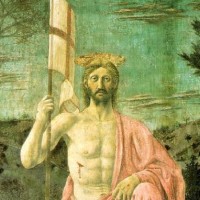
Piero Della Francesca, Italian Early Renaissance artist, whose circa 1450 work, ‘The Resurrection’ referred to in my Easter Saturday newspaper, brought a transcendental light on the road to Damascus moment to my mind. The power of art – to weave a story, to provide a narration, to inspire, to challenge, to comfort. What does Francesca’s ‘The Resurrection‘ mean for you? To me, my story – here is the power of the fecundity of nature, resurging from the dark days of winter to bring renewal, growth and vitality back to the land and us, all awakening from our slumbers. Our noble Earth, a mere yet significant speck in the vast dynamism of the universe. Urging to evolve, to establish to replenish, to rebirth, to make good the wrongs and injuries inflicted upon it and us. Humankind as a vital component within mother nature, within … Continue reading Piero Della Francesca ‘The Resurrection’