
JMW Turner and Cabbages: J.M.W. Turner demonstrated considerable artistic licence in his depiction of Chichester Canal, currently displayed at Petworth House in Chichester, West Sussex.
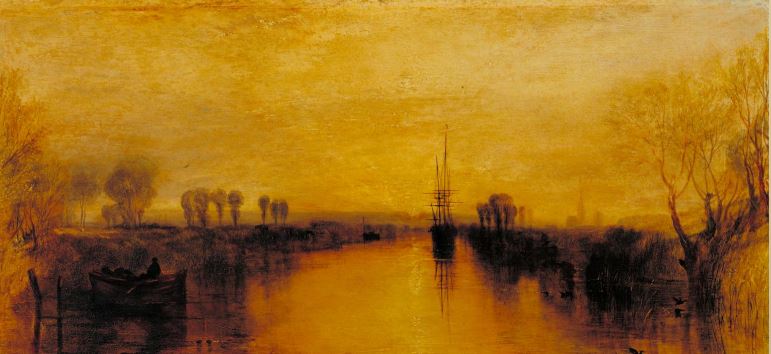
In the painting, the sun appears to be setting in the north rather than the west; this creative choice exemplifies Turner’s enigmatic approach. Rather than adhering strictly to accurate representation, Turner employed his considerable skills to produce works that were both aesthetically pleasing and spiritually resonant for viewers.
According to an art historian who recently lectured on Turner’s oeuvre at Petworth House, Turner was frequently hosted by Lord Egremont, the financier of the canal. In gratitude for this hospitality, Turner created several works capturing the house and its surroundings. Among these is a painting of the newly constructed Brighton Chain Pier, which remains on display at the house.
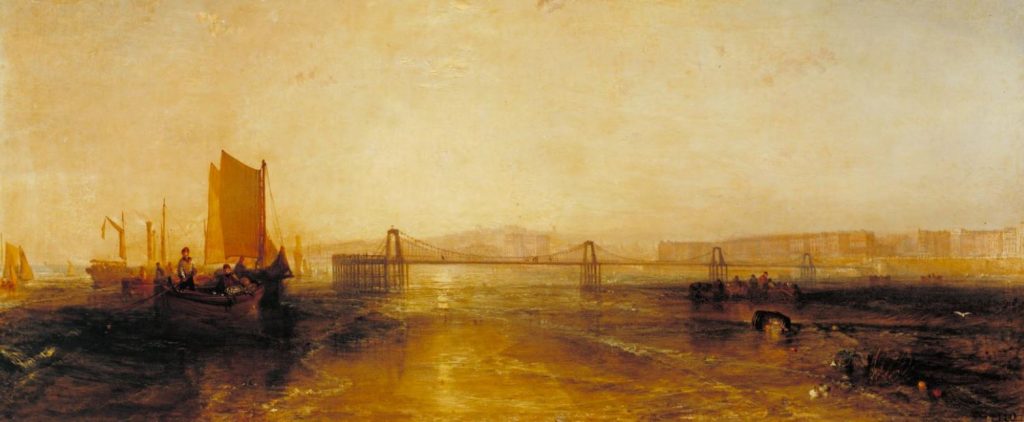
Turner is well known for documenting scenes from the Industrial Revolution, with notable works such as Rain, Steam and Speed. The Brighton Pier, constructed of metal and extending far into the sea, serves as a significant example of industrial progress during this period.
The same art historian pointed out that, in the lower right corner of the Brighton Pier painting, a broken barrel can be seen spilling cabbages into the sea. This detail sparked debate: Lord Egremont reportedly questioned the accuracy of Turner’s floating cabbages, having conducted an experiment at Petworth Lake which showed that cabbages sank in freshwater. Turner, however, responded by demonstrating that cabbages indeed float in the denser, salty seawater—a fact reflected in his painting.
Stories such as these offer unique insights into the context behind many artworks. While reading can provide background, first hand engagement with knowledgeable art historians offers invaluable perspective and depth.
JMW Turner and Cabbages
Source: (https://www.nationaltrust.org.uk/visit/sussex/petworth/jwm-turner-at-petworth-house-and-park)
Celebrated artist JMW Turner (1775-1851) enjoyed a long and productive relationship with Petworth House and Park, drawing great inspiration from the beauty of the estate. A number of his paintings of Petworth can still be seen here, giving a unique insight into what life was like on the estate during his time.
Turner was a frequent guest at Petworth, returning year after year, thanks to his friendship with George O’Brien Wyndham, 3rd Earl of Egremont (1751-1837). Several other artists of the time were repeat visitors too, including John Constable (1776-1837) and C. R. Leslie (1794-1859).
Turner enjoyed the beauty of Petworth – its interiors, collections and landscape – taking the time to observe, consider and record the great country estate without the usual constraints that were placed on a visitor to such a large house. This freedom to explore and create was encouraged by his enlightened and enigmatic host.
Petworth held many attractions for Turner, with its majestic landscape, magnificent interiors and wondrous collection, so by the late 1820s Turner was somewhat of a fixture at Petworth. In 1827 he produced some of his most striking gouache drawings of its interior and inhabitants.
Turner’s relationship with Petworth lead to a great commission of four final works by 3rd Earl of Egremont for the Carved Room. Each of the four scenes were specially created for placement within the wall carvings and depict scenes of significance to the 3rd Earl: two of Petworth Park, one of the Chain Pier in Brighton and one showing part of the Portsmouth and Arundel canal.
The two of Petworth Park can easily be compared to the real thing with just a glance through the windows of the Carved Room out into the park. These last two pieces celebrated the Earl’s philanthropy and support of such progressive schemes.
These four can still be seen at Petworth in the original places the 3rd Earl and Turner devised for them, thanks to a restoration project in the early 2000s which saw the paintings reinstated.
JMW Turner and Cabbages