
The starting point is the white ace of diamonds shape highlighted against the beigey brown map on the wall of the Dutch United Provinces. Vermeer’s Love Letter
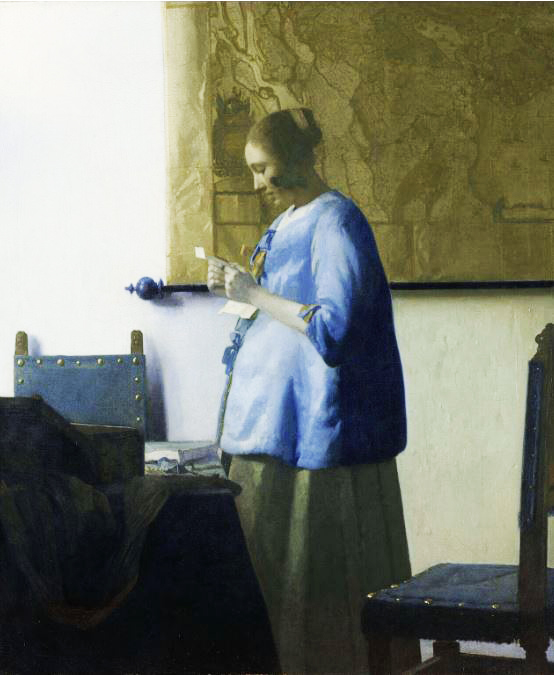
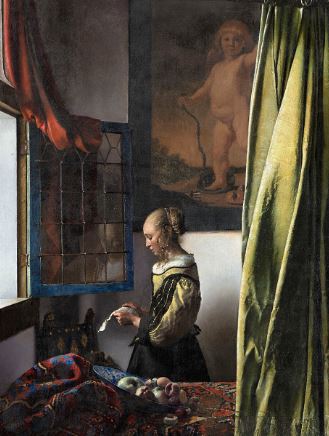
The diamond is the top of a letter catching the light from the window being read by a seemingly pregnant girl wearing a blue top. The date 1664. A dramatic comparison can be made with Johannes Vermeer’s earlier work of 1656, Girl Reading a Letter. Could this have been Johannes Vermeer’s new wife, Catherine? And therefore, could the older picture be Catherine now showing as an older woman and about to produce a child: Vermeer being the father?
Catherine was the daughter of Maria Thins. A devout Jesuit Catholic, who nevertheless graced her daughter’s marriage to the Protestant Johannes and indeed allowed them to live in her house until they became financially established. However, Johannes found it difficult to paint in Maria Thins’ house owing to the covert religious themes of his works. He therefore rented studios elsewhere keeping him away from home. Indeed, Maria Thins severely frowned upon Johannes’ Protestantism and especially his identification with the recently formed offshoot of Calvinism, the Remonstrance movement, and in particular the Collegiate sect.
Remonstrance practiced a form of Protestant Christianity quite distinct from traditional Catholicism. The movement grew within the newly formed United Provinces, created following the northern Dutch liberation from the dominant Spanish Netherlands part of the Habsburg Empire, after many years of warfare, to establish their independence.
Most of Vermeer’s works were painted for his primary benefactors, Pieter van Ruijven and his wife Maria de Knuijt who were prominent leaders of the Remonstrance collegiate movement. And Vermeer’s works, more than 20 of them, (of a known 34 totalling his work output) were for the house of the van Ruijvens which also served as a meeting place for the collegiate movement in Delft.
It is speculated that Vermeer’s works, at face value primarily focus on genre subjects, yet looking more deeply into his pictures, they convey subtle, intricate religious messages in such a manner far removed from the overt, almost fantasising religious painting of the Catholic Church. This particularly following the Counter-Reformation dictates on artists of that church determined at the 1648 Council of Trent.
The church in Europe was rent aside after the drama of Martin Luther’s 1517 94 Theses.
So Vermeer’s essential domestic scenes can be read as simply that of ordinary people doing ordinary things.
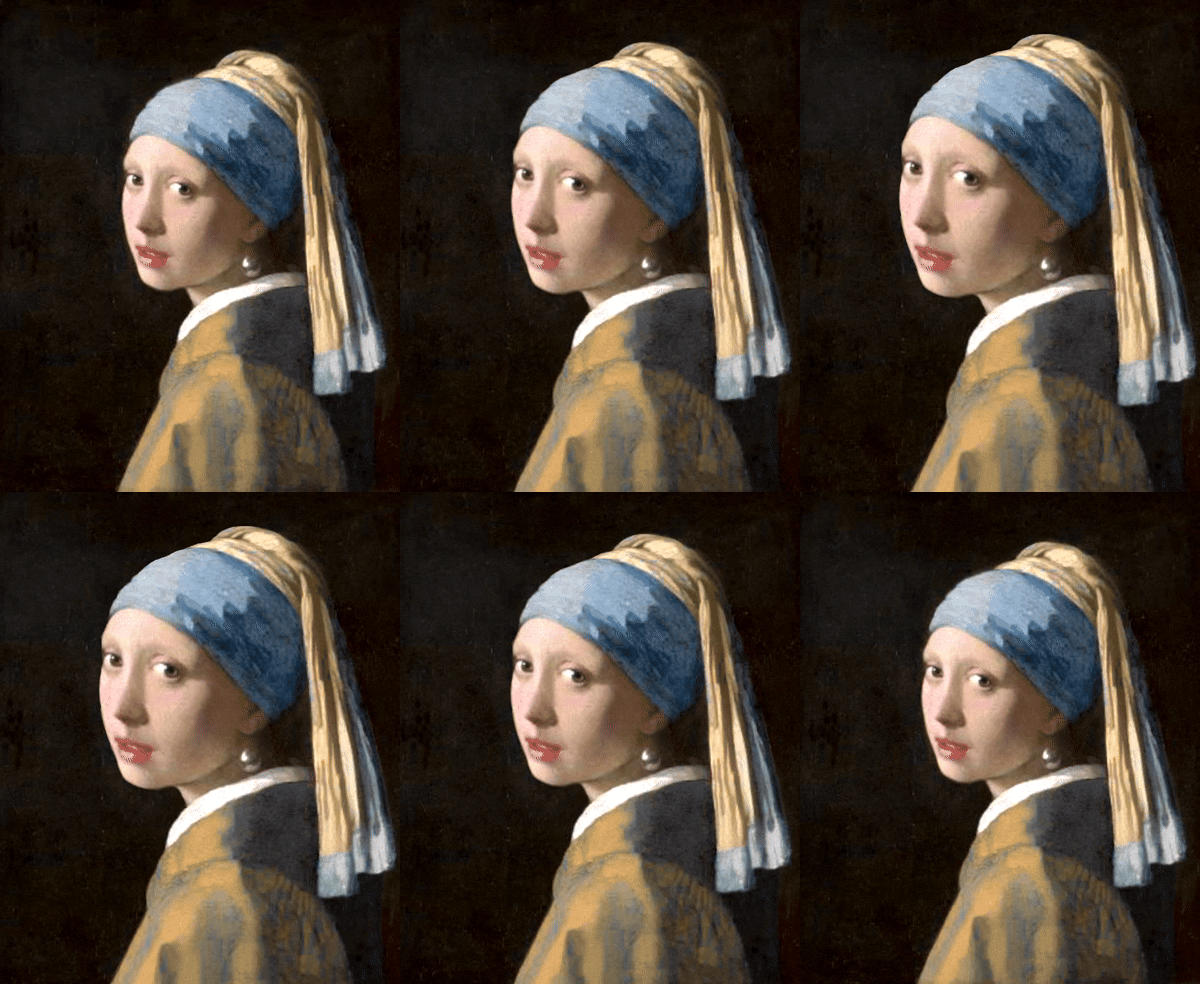
Or perhaps they mean more religious symbolism, as mentioned, cleverly and quietly reminding the Remonstrance attendees in the Van Ruven’s house of the Protestant interpretation of particular biblical stories. For example, The Girl in the Pearl Earring. This perhaps depicts the Van Reuven’s 13-year-old daughter, whose name was Magdalena. Mary Magdalene, looking into the tomb in wonder on Easter Sunday? Maybe.
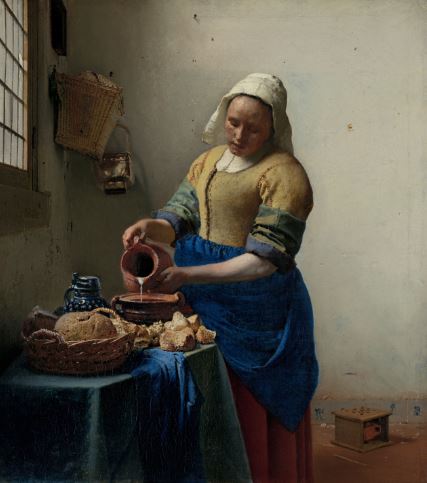
The Milkmaid, measuring milk, preparing a meal, taking care of the needs of others. Active, creating, nurturing, feeding. Giving. Could we have New Testament reference here? The Christian message of love, tolerance, thinking of and acting for others? Good deeds.
Maybe.
Returning to the woman in blue reading a letter, and now referring to a woman, not a girl, Johannes’ wife, Catherine, reading his letter, sent whilst he journeyed, as he often did throughout the United Provinces.
Catherine had recently been attacked by her psychotic brother, Willem, and fortunately was not too injured, and the foetus survived. Johannes was again away, as he frequently was, on some form of business, and this left his beloved wife Catherine alone at her mother’s house and thus vulnerable to the occasional visits of her disturbed brother.
So, a picture of love, of guilt at so many absences, an affirmation of togetherness.
The picture telling the story of what may be being expressed in the love letter in the hands of Johannes’s wife, Catherine.
Maybe.