
Vincent van Gogh The Sower
In 1888, a year before his death, Vincent van Gogh produced 30 drawings and painting versions of his iconic ‘Sower’.


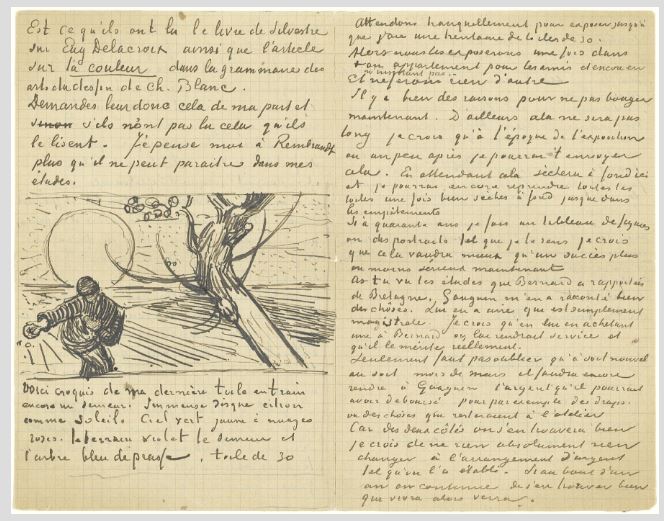
In a letter to his brother Theo, Vincent drew a rough sketch of a most famous version of his Sower. This was for Theo to recognise the genius of this work and to agree to try and sell it for Vincent.
With his paintings, Vincent used colours meant to express emotion and passion. Yellows, reds, blues, all with psychological undertones. Passions, sadness, illumination. And this was all before Sigmund Freud’s psychoanalysis became the vogue outside of Vienna.
He assigned the leading roles to the greenish-yellow of the sky and the purple of the field. The bright yellow sun looks like a halo, almost turning the sower into a saint.
Vincent was quite a religious man, but not in the form of recognising the canonical gospels or the formal church, but he saw God in every blade of grass, in the trees, the sky and of course the fecund earth itself.
The Sower could almost be interpreted as a religious work as well as perhaps a social commentary. The nobility of the peasant contrasting with the hard work and maybe the poverty of the country-folk at that time and place.
The two version of the Sower that we’ll be studying for our ‘Sip and Paint’ sessions are:
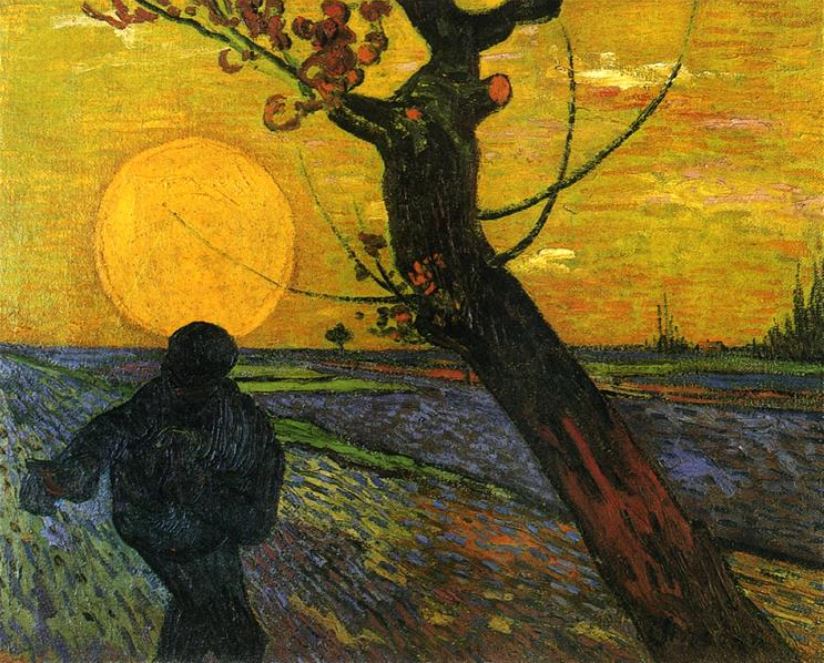
The Sower III (version 1), ‘The Sower with a Setting Sun’. Currently a part of the Emil Buhrle collection, Kunsthaus, Zurich, Switzerland. (72 x 92 cm).
And
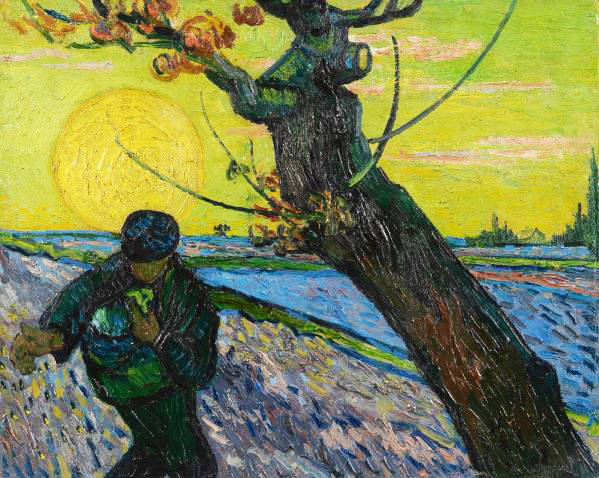
‘The Sower’ on display at the van Gogh Museum, Amsterdam. (32.5 cm x 40.3 cm).
Vincent enjoyed painting from reality, en-plain-air, in order to maintain his sanity as he maintained. His friend Paul Gauguin who became a foremost avant-garde artist with his development of symbolism said that Vincent should draw less on reality and more on his imagination.
This is what they primarily disagreed on. The ear. The departure from Arles. The journeys to the South Seas as we are aware.