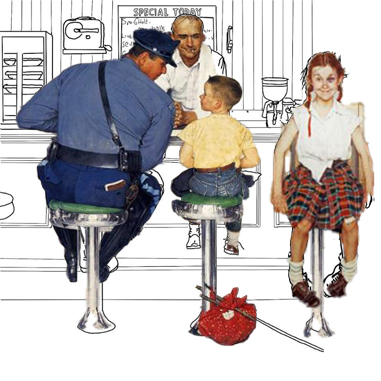
Friday 9th October marks the date for a fantastic evening with the artist Norman Rockwell – Paint & Sip – enjoying creating your own version of his iconic masterpieces. Runaway meets Shiner at Winchester ARC
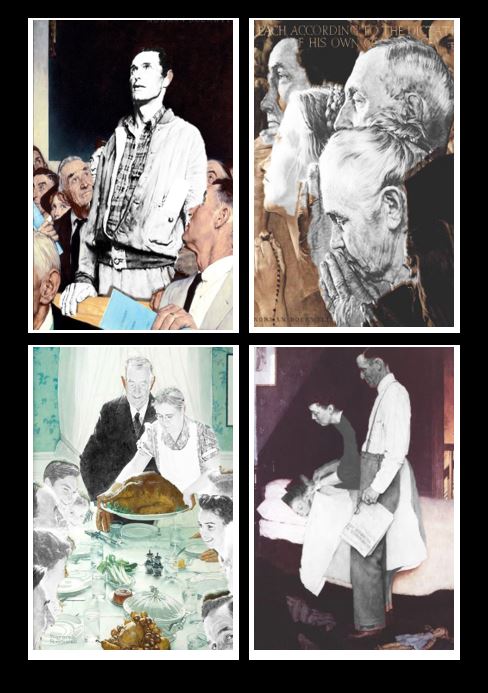
There will be a wonderful choice of several of Rockwell’s most well-known works:
The Runaway
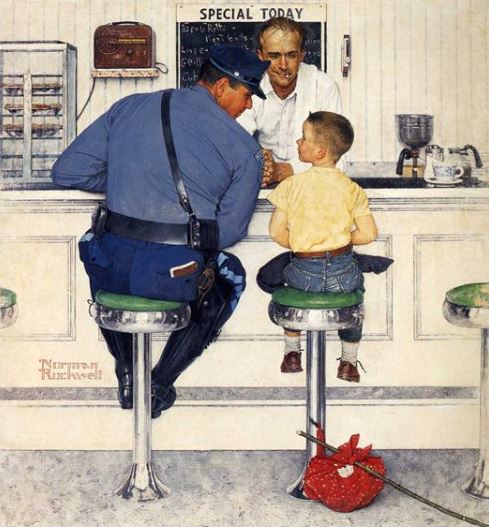
The Young Lady with a Shiner
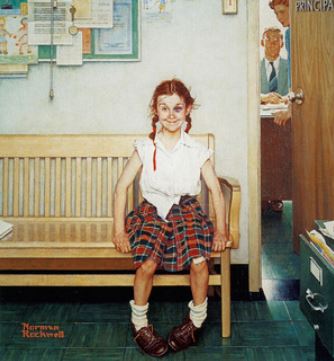
The Four Freedoms.
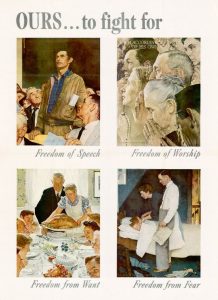
Online sourced descriptions of all these works can be found below.
Artists will have the choice of either starting with their own blank canvas, maybe with the help of a grid.
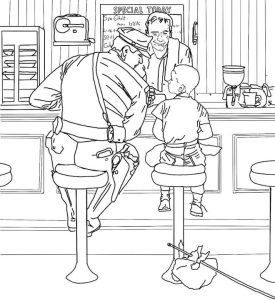
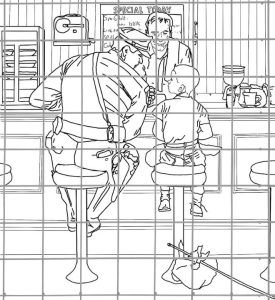
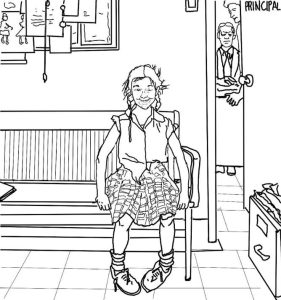
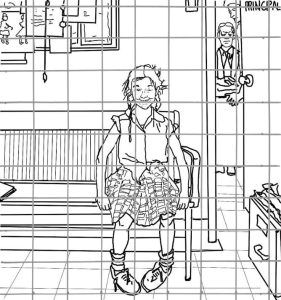
Sketched templates will be available for artists to enjoy using provided acrylic paints to complete the work(s) of their choice.
Copies of Norman’s paintings will help artists follow his colours or indeed to make their own decisions choices.
For the more complicated ‘Four Freedoms’ artists will be able to paint the principle protagonists against Norman’s original-coloured backgrounds. A most relaxing way of achieving a desired work of such important works of art.
The Story Behind The Runaway
Some paintings look simple until you realize they are asking a harder question.
Norman Rockwell’s The Runaway looks like a charming diner scene, but its meaning becomes warmer the longer we look. A little boy sits at the counter with a bundle tied to a stick. His clothes are neat, his shoes are still clean, and his posture is serious. He looks like someone who believes he has made a grown-up decision.
He has run away from home.
But Rockwell makes the scene funny because nobody else treats it like an emergency. The police officer sits beside him calmly, large and steady, almost like a wall between the boy and the outside world. He is not chasing him, scolding him, or making him feel foolish. He is simply sitting beside him.
The counterman leans in from behind the diner counter, watching the situation unfold. He understands it too. The adults know something the boy has not admitted yet.
This is probably not the beginning of a great adventure.
It is the end of a bad afternoon.
That is why the painting still feels so human. Rockwell does not mock the child. The officer gives him dignity. He lets the boy sit there with his bundle and his brave face, as if the little plan deserves to be heard.
The diner becomes a pause between childhood imagination and real life.
The painting is not about discipline.
It is about the rare adult who understands that a child’s small drama can feel enormous from the inside.
He thinks he is running away.
Everyone else knows he is deciding whether to go home.
The Story Behind The Young Lady with a Shiner
Out of the 321 covers that Norman Rockwell (1894 – 1978) created for the Saturday Evening Post, “The Young Lady with the Shiner” painted in 1953 was his 277th. It ran on the 23rd of May, and served as the third and final work by Rockwell The Post published that year.
To create the impressively detailed scenes that the artist is known for, Rockwell relied on meticulously planned photographic studies. So, when he was ready to paint “The Young Lady with the Shiner,” Mary Whalen — who modelled for the painting at the artist’s studio and, as a result, appeared on the cover of the Saturday Evening Post a total of three times — recalls that it took a few sessions to get the reference images.
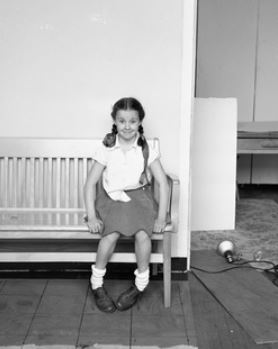
The black eye was the hardest thing to get right. Although Rockwell tried using makeup and then a mix of charcoal, neither proved to be realistic options. He needed a real black eye to copy, but he couldn’t find one, so he advertised for a shiner in the paper. When The Berkshire Eagle ran the story, it was picked up by the national wire and the artist quickly received more offers than he could sort through.
But, the model and the black eye are not the only the only subjects Rockwell copied from real life. He found inspiration in a high school in Cambridge, New York. According to NBC News: “Rockwell took photographs of the principal’s office and the door as well as the principal and his secretary. He even had the door taken off its hinges and brought to his studio. Later at his studio, he photographed models standing in for the principal and secretary.”
Norman Rockwell first met Mary Whalen when he was attending his son’s basketball game. The 11-year old was having an argument with her father, who was also the artist’s lawyer, about getting a drink of water. As he was trying to explain that refreshments could only be purchased at halftime, Rockwell — having overheard the conversation — offered her his coke. By the end of the day, the artist realized that Whalen would make a great model, thus kicking off their collaborative relationship.
“She was the best model I ever had,” fondly stated Rockwell, when asked about working with Whalen, “(she) could look sad one minute, jolly the next, and raise her eyebrows until they almost jump over her head.” Whalen had already modelled for one of Rockwell’s Saturday Evening Post covers when he asked her to pose for the “The Shiner.” “Wouldn’t you just love to win a fight with one of your brothers? That’s the kind of smile you have to have,” he enticed.
On the scheduled day, he called for her at school. Because the kid had never been summoned to the principal’s office before, Whalen was convinced she was in trouble and proceeded to cry, forcing her twin brother to hold her hand as she made her way over. But, much to her relief, she found Rockwell waiting for her instead. He earned the young model’s trust by being collaborative, and by asking her to call him Norman, like his peers.
In an interview she gave years later, Whalen recalls:
“I was reserved and he would just sort of pull [the expressions] out of me by laughing or clapping or stomping his feet or jumping up and down and making me laugh, that kind of thing. And I just felt such a part of what was happening. As a kid, I liked to be a part of something. He knew what he wanted and he knew how to get that out of you. And then when he got [the right expression], he would just shout, ‘Oh, that’s wonderful! That’s wonderful!’
“My recollection of working out this picture with Norman [above] is one of laughter and fun. He showed me the sketch and wondered what I thought about it. I got it. It was about role reversal. For once the little girl was victorious, and it did not matter that she had a black eye. That was the mark of the trophy!
“These posing sessions were filled with lots of Norman’s laughter as he knelt on the floor and pounded his fists to get the smile he wanted …”
The original oil painting of “The Young Lady with the Shiner” is currently at the Wadsworth Atheneum Museum of Art located in Hartford, Connecticut.
Runaway meets Shiner at Winchester ARC