
Battle of Britain Memorial Kent. This is a place that must be visited. Poignant, thrilling, sad, proud, this is a memorial and museum dedicated to the ‘Few’ the Battle of Britain pilots who saw off the Luftwaffe during this most pivotal moment of Britain’s, Europe’s and the free world’s history.
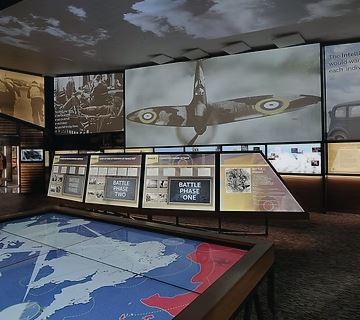
The museum features a brilliant display of film, pictures, artefacts, software, maps, and many other features to bring home the reality of those few weeks from July to October 1940 when overwhelming odds were prevented from making the invasion of the UK possible by establishing and maintaining air superiority.
“While the Trust’s focus is on the bravery and sacrifice of the Few, the airmen who flew against the Luftwaffe in 1940 to prevent an invasion of this country, it recognises that they did not achieve that success on their own.
Many thousands of people worked behind the scenes to keep the Few in the air, repair the runways, keep communications flowing, look out for incoming enemy aircraft and fill many other support roles.”
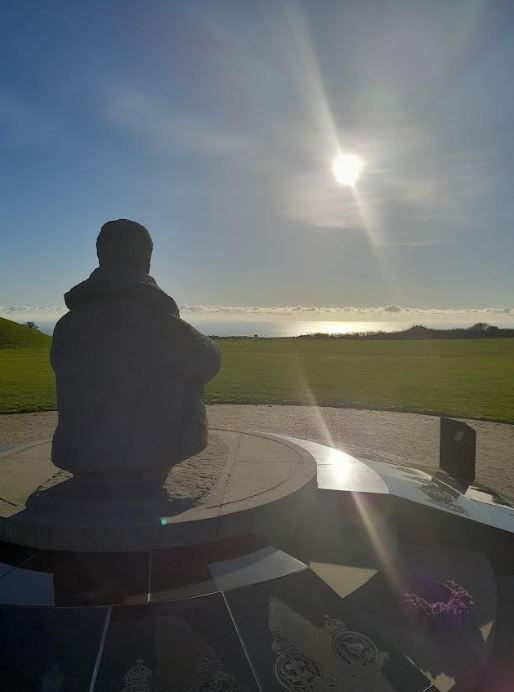
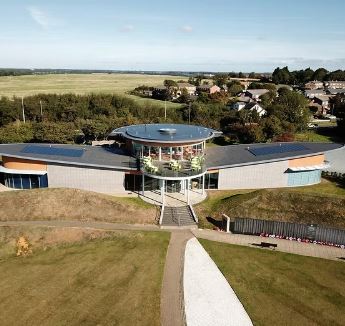
The memorial is on the cliff edge overlooking Dover and Folkstone and in the far distance, on a clear day, France can be seen, bringing home the close proximity of mainland Europe and how close the country was to the Nazi threat in 1940.
The story of the central sculpture:
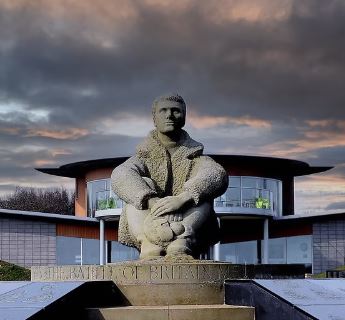
The central statue was carved by Harry Gray of the Carving Workshop in Cambridge.
He later revealed that after being asked by the Battle of Britain Memorial Trust to create the focal point of the site, he settled on the idea of a pilot but found it difficult to come up with a design he was happy with.
Then one day, during a break, Harry’s trainee sat down and adopted a contemplative pose that provided the sculptor with the inspiration that had previously eluded him.
That lunchtime pose was the blueprint for the statue of the seated airman looking out to sea that is striking in its simplicity yet so moving in its context.
The figure wears an Irvin jacket for a very important reason; by hiding the airman’s uniform it disguises both his nationality and his rank. Is this a British officer with half a dozen kills to his name or an NCO gunner from another country? Both played their part and the Memorial reflects that fact. That same reasoning is behind the fact that the Christopher Foxley-Norris Memorial Wall reveals neither rank nor decoration.
That central figure sits on a propeller boss surrounded by the badges of all the Allied squadrons and other units that took part in the Battle. The blades of the propeller are set into the ground, making the memorial as striking from the air as it is for the visitor on the ground.
On 9 July 1993, Her Late Majesty Queen Elizabeth the Queen Mother flew in by helicopter to perform the official unveiling ceremony in wet and windy conditions that were again in evidence when her daughter, Her Majesty The Queen, unveiled The Wing on 26 March, 2015. There is a story that in 1993 the helicopter pilot suggested that they should turn back because conditions were so poor. The Queen Mother is reported to have said “My boys never turned back, we will carry on”
Battle of Britain Memorial Kent