
Tonight (Friday 4th December 2026 6.30 to 9.00pm) we’re going to have a relaxing and enjoyable fun evening looking at the work of American artist Grant Wood. American Gothic and Paul Revere
Grant Wood is especially known for his work ‘American Gothic’ which hangs in the Art Institute of Chicago.
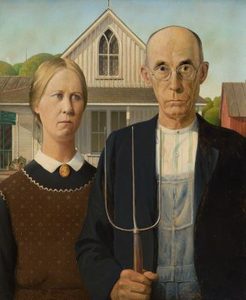
Painted in 1930 it shows two people looking like either a husband with a much younger wife or a father and spinster daughter.
It’s probably well-known now that the figures are Wood’s sister Nan Wood Graham and his dentist Dr Byron McKeeby.
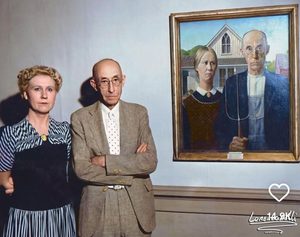
Wood intended the piece as a respectful, positive tribute to the resilience and steadfast spirit of rural Americans at the start of the Great Depression. However, the tight-lipped expressions and stiff pose led many viewers to read it as a sharp satire of small-town narrow-mindedness and puritanical rigidity.
When the painting debuted at the Art Institute of Chicago in October 1930, it won a bronze medal and a $300 prize. It generated immediate anger in Iowa, where residents felt insulted and caricatured as “grim Bible thumpers”
Over time, the painting shifted from local controversy to a beloved national symbol of American pioneer values and became one of the most frequently parodied images in popular culture
This will be an enjoyable painting for artists to create their own version of or have a go at making a copy of it. It will be one of the easiest subjects that we’ve had at the ARC paint & Sip.
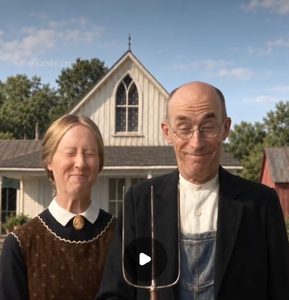
A post shared by Accursio Graffeo (@accursio_grf)
Our other picture tonight is Grant Wood’s almost a cartoonist style ‘The Midnight Ride of Paul Revere’ 1931 depicts the American patriot Paul Revere during his midnight ride on April 18, 1775. The perspective is from a high altitude as Revere rides through a brightly lit Lexington, Massachusetts. It was inspired by the 1860 poem “Paul Revere’s Ride” by Henry Wadsworth Longfellow. Wood used a child’s hobby horse as model for Revere’s horse.
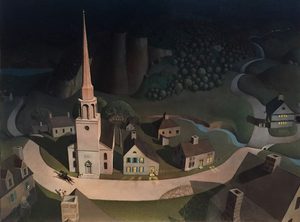
The painting is located at the Metropolitan Museum of Art in New York City and the story behind the paint is:
The Mission: Dr. Joseph Warren dispatched Paul Revere and William Dawes from Boston to Lexington, Massachusetts. Their job was to warn Patriot leaders John Hancock and Samuel Adams that British regular troops were marching to arrest them and seize rebel gunpowder stockpiles in Concord.
The Lantern Signal: Robert Newman, the sexton of the Old North Church, hung two lanterns in the steeple to signal that the British were crossing the Charles River by boat (“two if by sea”) rather than marching via Boston Neck.
Not a Solo Ride: Revere was part of a large messaging network. William Dawes took the land route out of Boston Neck, and the two men later met up with a young physician named Dr. Samuel Prescott on the road to Concord.
What He Actually Said: Revere did not shout “The British are coming!” because the colonists still considered themselves British. He likely used a quiet code like “the regulars are coming out”.
American Gothic and Paul Revere